
Getting Sequatchie County Court Records
Dig out any notice, order, summons, or citation first. It names the court and may carry the case number. Circuit Court records belong with Karen L. Millsaps, the Circuit Court Clerk. Chancery, probate, estate, and equity files sit with the Clerk and Master. General Sessions, Juvenile, and Dunlap City Court each follow their own route. A search at one office is not a search of all Sequatchie County court records.
The county offers no online trial-court docket search. Access runs through the clerk counter, a phone call, mail, or a specific written request. Email works only if the clerk agrees. Ask at the counter about a public terminal or a daily docket printout. Neither service is advertised online. The statewide Tennessee Public Court Records site omits Sequatchie from its office selector. Public Case History helps only once a matter reaches a Tennessee appellate court.
- Identify the court, caption, case number, and the date or event tied to the desired item.
- Call the proper clerk to confirm custody, public status, request method, current fee, and response time.
- Visit the counter or send a detailed request by the method that office approves.
- State whether a plain printout, filed document, recording, transcript, or certified copy is needed.
- For an appeal, search Public Case History, then contact the trial clerk for the local file.
Sequatchie Court Record Custodians
Which clerk holds a file depends on the court, not the county name. Karen Millsaps keeps Circuit Court records. She takes filings, collects costs and fines, and issues Circuit certifications. The Clerk and Master keeps Chancery material. That office normally routes probate and estate files. General Sessions, Juvenile, and Dunlap City Court each have separate clerk paths.
Circuit Court Clerk
Karen L. Millsaps
351 Fredonia Road, Suite B
Dunlap, TN 37327
(423) 949-2618
Monday through Thursday, 8:00 a.m. to 4:00 p.m.
karen.millsaps@tncourts.gov
Clerk and Master
22 Cherry Street, P.O. Box 1651
Dunlap, TN 37327
(423) 949-3670
The AOC lists Jared Smith and jared.smith@tncourts.gov. The county directory carried an older name, so verify before mailing.
The Tennessee judiciary clerk profile documents the Circuit office shown below.
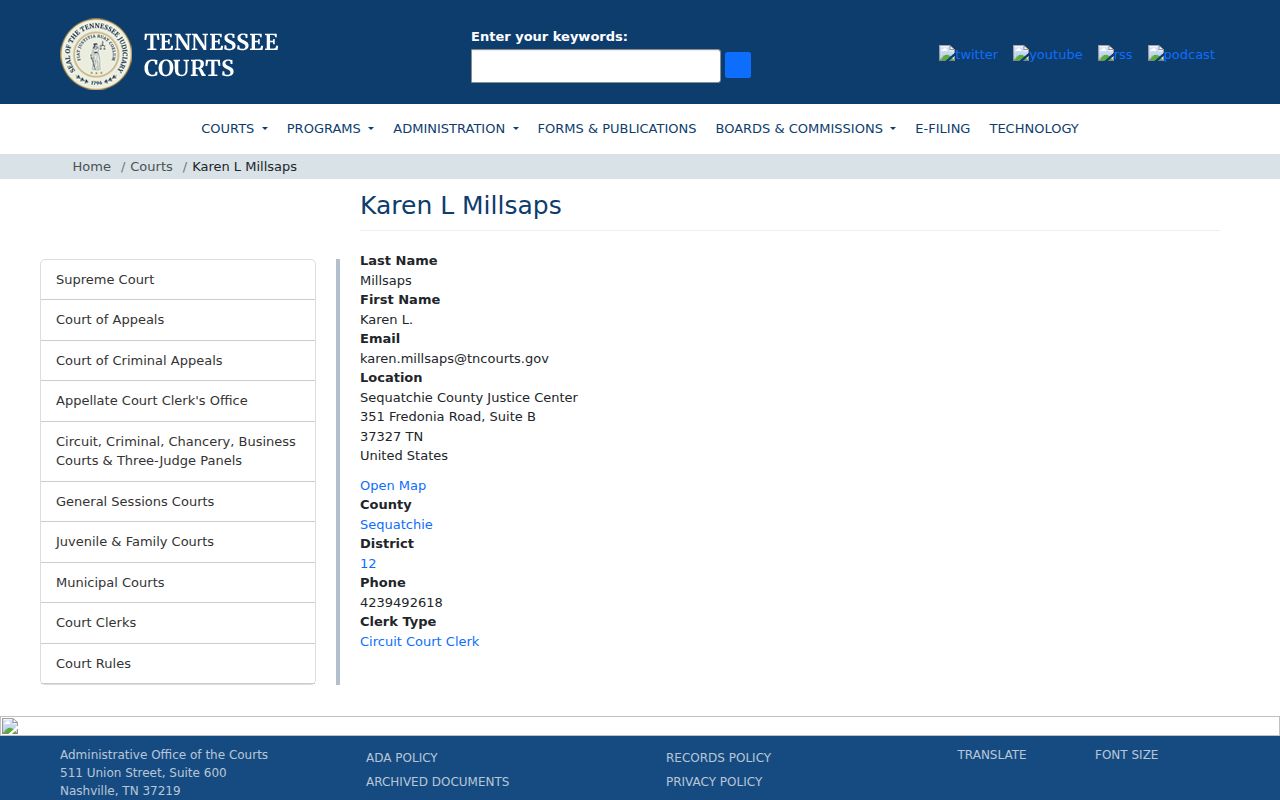
Circuit certification and record questions go to the Circuit clerk. They do not go to an unrelated county office.
Sequatchie County Court Record Types
"Court record" covers more than one kind of item. Name the exact document you want. That avoids delay and avoids paying for a file that misses the point. The Circuit clerk may hold criminal charging papers, motions, orders, and judgments. Civil pleadings, appeal records, cost ledgers, and available recordings may sit there too. The Clerk and Master handles Chancery pleadings, orders, and judgments. Domestic-relations records held there, probate or estate documents, and docket-call material round out that office's files.
- A docket sheet showing filings, settings, and rulings
- A complaint, petition, answer, motion, exhibit, notice, order, or judgment
- A cost ledger, fine balance, payment entry, or fee-waiver entry
- An appeal record or cross-reference to an appellate case
- An authorized recording or a separately prepared transcript
- A plain photocopy or clerk-authenticated certified copy
General Sessions may hold lower-level criminal, civil, and traffic entries. Juvenile material carries special limits. Dunlap City Court supplies municipal citation and ordinance information. The County Clerk's vehicle office is a different custodian and holds none of these court files.
Three Sequatchie Record Layers
A docket entry, the document behind it, and a certified copy are three different things. A Sequatchie County court docket is the register of events. It may show that an order was filed on a certain day. The text itself is not there. The filed document holds that text. Certification is the clerk's authentication of a copy.
| Record layer | What it answers | What to request |
|---|---|---|
| Docket sheet | What was filed or set, and when | Current register or date-limited events |
| Filed document | The words in a motion, order, pleading, or judgment | Exact document by title and entry date |
| Certified copy | An authenticated version from the custodian | Certification of the named document |
If a docket says "disposed," ask for the final entry or order. That word alone tells you little. It will not say whether the outcome was a dismissal, plea, judgment, transfer, or something else. The state civil manual uses 77A1 for Circuit and 77A2 for Chancery. A code, though, does not prove every related paper sits in one office.
Inside a Sequatchie County Court Record
What a record displays depends on the court and the case type. The county posts no live local trial interface, so request fields here come from clerk duties, AOC reports, and District 12 rules. Ask the clerk which fields appear in the public copy.
| Case header | Case number, filing date, court, type, caption, judge, status, and disposition date. |
|---|---|
| Parties | Public role labels and attorneys, subject to redaction and confidentiality. |
| Events | Date, event type, description, filer or source, and document reference. |
| Settings | Date, time, place, part, judge, setting type, and reset status. |
| Financials | Costs, fines, restitution, balances, payments, and indigency entries. |
| Outcome | Dismissal, judgment, plea, conviction, diversion, nonsuit, or transfer. |
| Restrictions | Sealed markers, masked identifiers, and document-level limits. |
A clerk may hand over a public printout with no online images. TennesseeCaseFinder's restricted login does not mean a public user can pull Sequatchie filings. Ask whether an image, paper copy, redacted copy, or inspection appointment is available.
Specific Sequatchie Records Requests
Tennessee access rules demand enough detail for the custodian to locate the record. An office need not dig through many files. Nor must it build a new report from a broad demand. Include your contact details, the court, the case number, and the caption or your role if known. Add the exact record, the date range, the preferred format, and plain or certified copies.
Ask about office policy, a fee estimate, payment methods, and a completion date. Find out whether you need identification, Tennessee citizenship proof, or a stamped return envelope. A directory email address is no promise that a clerk takes copy orders by email. Confirm first.
If a document is not online: Send the same narrow description to the named court custodian and request inspection, a plain copy, a certified copy, or a redacted public version.
The AOC takes requests for records it holds through its Nashville office, phone, mail, and AOCpublicrecords@tncourts.gov. That policy does not govern a local Sequatchie trial file. Send a county record there only when the AOC is the actual custodian.
Fees and Certified Copies
The county publishes no official schedule for plain copies, certifications, searches, or electronic documents. The AOC General Manual lists statutory clerk service charges, but those entries are not a current Sequatchie County quote. Get a written estimate before ordering a large file.
| Item | Verified amount | Request note |
|---|---|---|
| Plain trial copy | Not located in official local sources | Ask for the current quote. |
| Certified trial copy | Not located in official local sources | Name the exact filing. |
| Local record search | Not located in official local sources | Ask if a no-number search costs more. |
| Advance audio duplicate | $50 per medium | Rule 26 rate when applicable. |
| Later audio duplicate | $100 per medium | Existence must be confirmed. |
Rule 26 waives fees for indigent parties in its set circumstances. A transcript is separate and may carry reporter charges. Confirm whether a recording exists and which office can release it.
Sequatchie Audio and Transcripts
A hearing entry on a Sequatchie County court docket does not mean audio exists yet. It does not promise a transcript either. Tennessee Rule 26 governs authorized electronic recordings. The clerk must confirm whether one was made. When you ask, give the hearing date, court part, and case number. Say whether you want audio, a transcript, or both. The AOC General Manual sets out the statewide clerk fee context.
The table describes the kinds of charges clerks impose. It cannot replace a current quote from the Sequatchie County office, so ask before you budget for copies.
Sealed Records and Public Access
Tennessee Supreme Court Rule 34 gives the public a right to inspect court records. A law, rule, or order can say otherwise. Case records, administrative records, and judicial records all fall under it. The rule still shields certain material, though. Sealed documents and records made confidential by statute stay protected. So do unpublished drafts, judge-use copies that were never filed, internal deliberative papers, and information whose release would impede a judicial function.
Tennessee access baseline: Tenn. Code Ann. §§ 10-7-503 and 10-7-504 govern access and confidential categories with Rule 34. Rule 114 adds juvenile confidentiality.
A docket can be public even when part of the file is not. An exhibit, a medical record, a financial filing, or a personal identifier may sit under seal. It may also come back redacted. Juvenile dependency and neglect cases are confidential in full. If a clerk denies you, ask for the public portion. Also ask for the rule or order behind the denial, and whether a redacted copy or a motion for access is an option. A missing docket entry can also trace to expungement. That alone proves no historic matter existed.
When Sequatchie Custody Is Unclear
Who holds the record is not always obvious in Sequatchie County. The state judiciary directory is the stronger starting point when names or offices shift. Verify the office, its address, and its preferred method. Do this before you mail or fax a request. If a court redirects you, keep that note. Send the same focused description wherever it points you.
For Circuit Court matters, use Karen Millsaps. For Chancery, probate, and estate questions, begin with the Clerk and Master. For lower-court matters, call Sessions and ask where the public register is kept. A municipal citation belongs to Dunlap City Court. When all you have is a party name, start with the Sequatchie County case lookup. Then return to the clerk for the documents themselves.
Going court first prevents false negatives. Each court keeps its own numbers and its own register. One office coming up empty proves only that its docket was searched, not every court's.