
How to Search Cases by Name
No public Sequatchie County name search returns results from every local court at once. So begin with whatever court a summons, citation, or order names. No paper in hand? Sort out the case type first. Felonies and major civil matters land in Circuit Court. Chancery holds equity, most domestic-relations, probate, and estate cases. General Sessions takes lower-level criminal and civil work, while Dunlap City Court handles municipal matters.
- Identify the likely court from the newest case paper, event, or type of dispute.
- Give the clerk the party's full name, role, approximate filing year, and case type.
- Add any known lawyer, judge, citation, or related case reference to narrow the request.
- Ask for the case number and public docket sheet before requesting a particular filed document.
- Verify that the caption, court, filing year, and case type match the matter sought.
Ask narrow. One case beats every record tied to a common last name. Circuit Court records sit with Karen L. Millsaps at (423) 949-2618, 351 Fredonia Road, Suite B. Chancery requests go to the Clerk and Master. That office is 22 Cherry Street, (423) 949-3670. For Sessions, start at (423) 949-4159. Dunlap City Court answers at (423) 949-3319, 119 Church Street.
| Search field | Type | Required | Useful detail |
|---|---|---|---|
| Party name | Text or clerk request | When number is unknown | Full spelling and party role reduce false matches |
| Approximate year | Year | No | Use the filing year, if known |
| Case type | Category | No | Criminal, civil, probate, juvenile, or municipal helps route the request |
| Court | Office selection | Practically yes | Sequatchie records are decentralized |
| Case number | Identifier | No | The strongest key when available |
Sequatchie County Case Lookup Gap
Tennessee Public Court Records, called TnCrtInfo, offers a statewide form covering participating trial-court offices. Sequatchie County does not appear in its court-office selector. Picking some unrelated East Tennessee office will not reach a Sequatchie trial docket. TennesseeCaseFinder is no public substitute either, since it sits behind a government login.
The form itself shows how these searches usually work. It takes a party name or a case reference, not both. Then it offers case year, case number, criminal or civil case type, and a required court-office choice. A Turnstile check unlocks the Find Now button. Help notes cap results at 2,500 rows. The column filter works literally and in real time. Those are TnCrtInfo features, not a Sequatchie database.
The official search form, with no Sequatchie option listed, appears on the TnCrtInfo page.
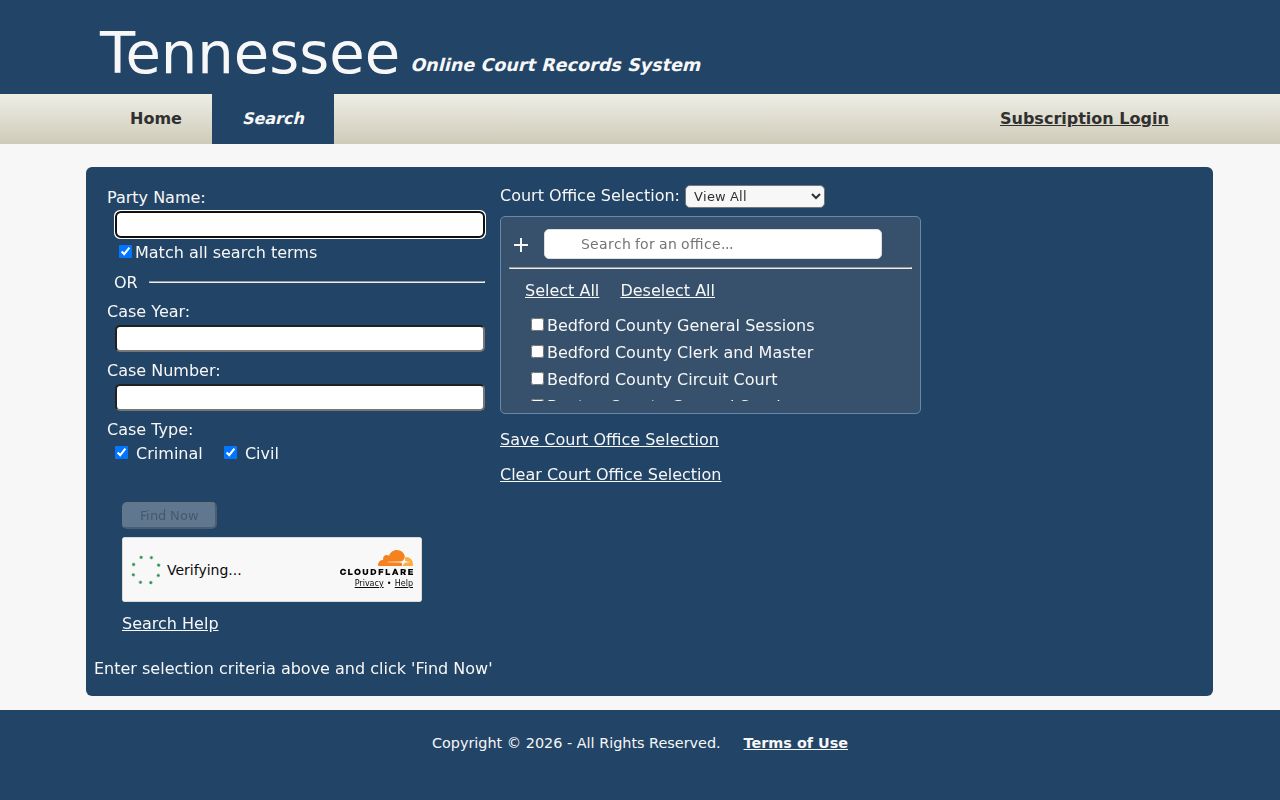
That gap points back to the clerk as the fallback. It means only that the statewide interface does not expose Sequatchie County's trial office, not that no records exist there.
How to Search by Case Number
The case number is the sharpest lookup key. It ties a request to a single court file. Copy it exactly, including letters, digits, and any location or case-type codes. One AOC criminal reporting example uses the compact pattern 77CC12023CR6. Not every clerk screen shows that pattern. Never reconstruct missing digits or treat the example as a universal local format.
TnCrtInfo help describes a different style, 99GS1-2023-CR-12345. It says to enter only the final numeric portion after the last hyphen in its Case Number field. That rule belongs to the portal's form alone. For a clerk, give the full identifier exactly as printed and name the issuing court. Suppose a number will not fit the public form. TnCrtInfo advises switching to Party Name or Case Reference.
A number can also point to the wrong level of court. Trial and appellate numbers differ. After an appeal is docketed, Tennessee Public Case History can find its appellate identifier. The originating clerk still keeps the trial register and certified record. Ask the clerk about any appeal cross-reference rather than assuming one number works everywhere.
Sequatchie County Case Search Request
When the web turns up nothing, send a focused request to the right office. Name the court. Include the case number if you have it, the party's role, the rough filing year, and the record you need. Ask first for a docket sheet or dated event list. Once you spot an entry, get specific. Request the specific order, judgment, motion, or pleading by date and title. That step can save you from paying for material that never answers the question.
- Circuit Court: Karen L. Millsaps, 351 Fredonia Road, Suite B, Dunlap, (423) 949-2618.
- Chancery Court: Clerk and Master, 22 Cherry Street, Dunlap, (423) 949-3670; verify the current name.
- General Sessions: begin with the judge or clerk office at (423) 949-4159 and confirm its records counter.
- Dunlap City Court: 119 Church Street, (423) 949-3319; official sources conflict on the clerk name.
- Juvenile Court: call the local judge or clerk route because many records are confidential and no public portal was found.
Ask the clerk what access works. Options range from in-person inspection and a public terminal to mail, email, or a printed docket. The county does not advertise a public terminal. Confirm by phone. A Tennessee Public Records Act request should describe the record with care. Court secrecy and access rules still govern release. Always ask for a fee and time estimate before ordering copies. The county directory and the Circuit Clerk profile are official places to check current contacts.
What a Case Search Shows
A docket or case result is an index of court activity, not the full story. It can list the case, public parties, court, filing date, status, judge, settings, and dated events. Financial fields or document references may show up too. The county's own public display is limited. Treat state reporting fields as things to request, not things promised online.
| Case number | The court-assigned identifier, with any location, year, type, and sequence elements. |
|---|---|
| Case style | The caption and public party roles, used to distinguish similar names. |
| Court and type | The venue and category, such as Circuit criminal, Chancery, Sessions, juvenile, or municipal. |
| Filed date | The date the case or initiating filing was accepted. |
| Status | An open, disposed, dismissed, transferred, or other recorded state, which needs context. |
| Event list | Dated filings, notices, settings, orders, and dispositions, where public. |
| Next setting | Date, time, court, judge or part, setting type, and any reset marker. |
| Documents | References to pleadings or orders; an index entry does not guarantee a downloadable image. |
A name hit is not a judgment. A status label is not the whole file. A setting can move, and an entry can linger after later activity changes what it means. For the current hearing date, follow the separate Sequatchie County court dates process and confirm with the clerk in control of the case.
Sequatchie County Case Image Access
A docket sheet and a filed image are different things. The docket is the running log: filings, events, settings, outcomes, all in order. An image is the real paper behind an entry. Think of the complaint, a motion, an order, a judgment, an exhibit, or a notice. A certified copy goes one step further, because the clerk authenticates it.
One caution belongs here. Spot an entry on a Sequatchie County court docket. That does not mean the image behind it is open online. And a one-line index description is never a substitute for reading the judge's actual order.
| Record layer | What it answers | How to obtain it |
|---|---|---|
| Docket sheet | What happened and when | Ask the originating clerk for the public register or printout |
| Filed document | What a specific filing or order says | Identify its date and title, then request the public image or copy |
| Certified copy | Provides clerk authentication of the record | Order from the court clerk and confirm current certification fees |
Sequatchie County posts no fee for a trial-level online document view, and the court offers no live local image interface. So do not assume images are free or instant. Before ordering, ask the clerk about plain versus certified copies, delivery method, redaction, and the current cost.
County vs Statewide Case Search
Tennessee runs statewide tools. But the practical Sequatchie County trial search stays local. TnCrtInfo serves participating trial offices, and Sequatchie does not appear in its selector. Public Case History covers the Supreme Court. It also covers the Court of Appeals, the Court of Criminal Appeals, and the C-Track Appellate Clerk. That makes it an appellate index, not a county trial portal for docket lookup.
| Search route | Coverage | Best use |
|---|---|---|
| Sequatchie clerk | The named local court's register and file | A known trial matter, current setting, docket printout, or certified copy |
| TnCrtInfo | Participating Tennessee trial offices; Sequatchie absent when inspected | Checking public trial data only where the correct office is selectable |
| Public Case History | Tennessee appellate courts | An appeal after it has reached the appellate clerk |
| TennesseeCaseFinder | Restricted login environment | Not a public replacement for a Sequatchie clerk search |
The Public Case History portal offers several search fields. Use Case Number, Case Style, Party Name, or Business/Organization. According to AOC, its data runs current through the end of the prior business day. Motions, orders, judgments, and opinions appear directly, but only for stated appellate date ranges. For anything more current on appeal, contact the appellate clerk.
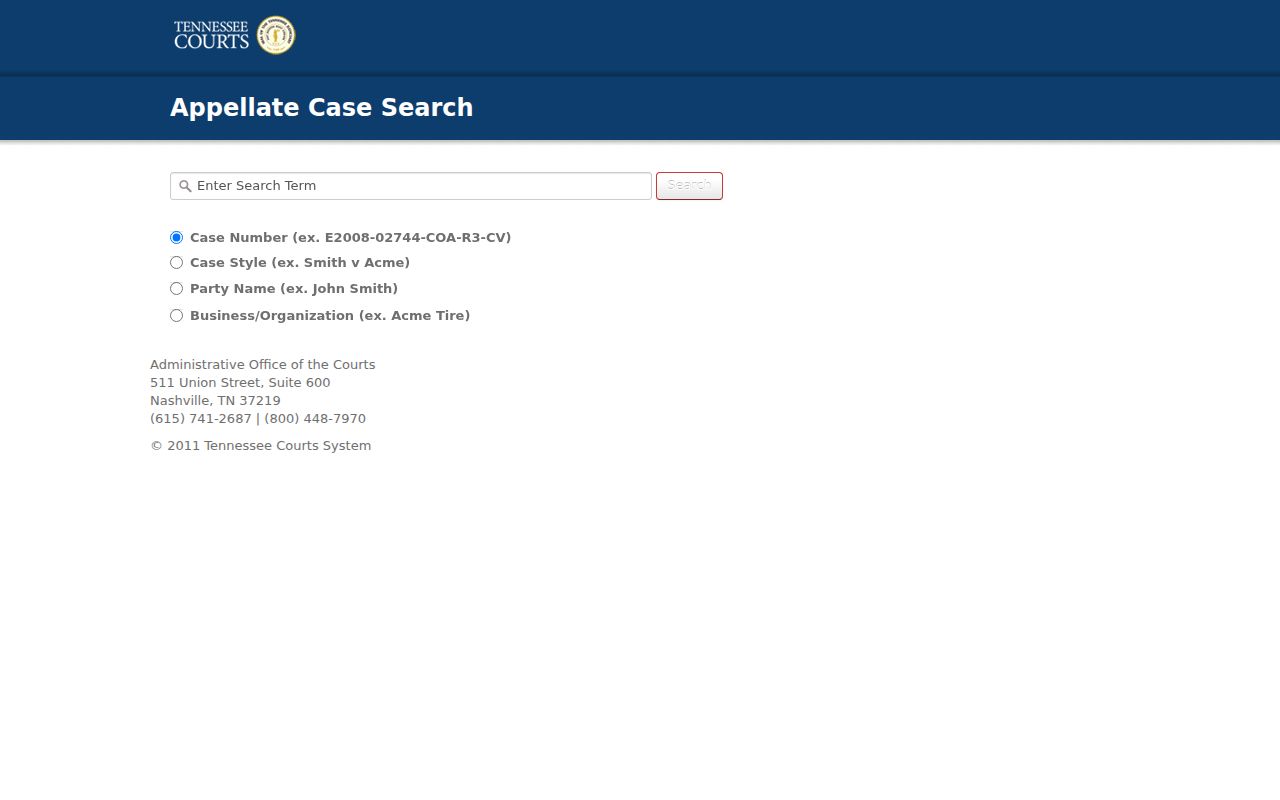
That official portal is a useful appellate route. Still, it is not a live Sequatchie County trial-case database.
When Sequatchie County Search Fails
A blank result can mean several things. You may have searched the wrong court. The name may be spelled differently in the system. A case can predate the available data, sit in a local system, or have moved to an appellate court. It might also be sealed, expunged, juvenile, or restricted at the document level. An empty web hit never proves no case exists.
Work backward from paper. Pull the newest filing and read the court name at the top. Then call that clerk with the full case number. If no number exists, offer a narrow set of facts instead of a broad story. Ask whether the clerk can check the local TnCIS environment, whether an older or alternate number exists, and whether the public can use a terminal or get a printout. If the answer is no, request the court's written access policy and the lawful reason for the restriction.
Best next check: verify the court before broadening the name search. Circuit, Chancery, Sessions, Juvenile, and Dunlap City Court are separate paths.
Sequatchie County Appeal Case Search
Every trial case starts local. The Sequatchie County court and its clerk hold the file first. A party may take an authorized appeal. The record then gets filed, and the appellate clerk assigns and maintains the new case. From that point, Public Case History can show appellate events and eligible documents. The Sequatchie clerk still keeps the trial docket. The exhibits stay there too, along with local orders and the certified trial record.
Know the appellate case number? Search with it. A case-style or party-name search works when the number is missing. Match the originating county and trial number before opening any result. Public Case History covers Tennessee's Supreme Court, Court of Appeals, and Court of Criminal Appeals. Federal cases run separately. They use PACER and the Eastern District systems, so a federal docket never shows up in a Sequatchie County trial lookup.
Restricted Cases and Access Rules
Tennessee Supreme Court Rule 34 sets the baseline for public access to court records. It also calls for trial-court access policies. Access is not absolute. Juvenile dependency, neglect, and delinquency records carry confidentiality rules. Sealed matters, protected personal data, adoption material, and some family records may be withheld or redacted. An expunged criminal record may drop out of an ordinary public search entirely.
A restricted result and no result are not the same thing. The public might see a docket marker while the document behind it stays closed. Or the public might see nothing at all. Never try to bypass a restriction. Instead, ask the clerk what public portion, if any, can be inspected and what court order or authorized status would open more. On your own restricted matter, bring identification and the case number and follow the clerk's process.
Tennessee Public Records Act requests must be specific. The Comptroller describes how citizenship, identification, fee, and statutory-exception rules can apply. Court-record rules still govern court files. A request sent to the AOC does not automatically reach a county-held docket. Direct it to the clerk who maintains the case. Confirm any fee, response method, and redaction before you rely on the result.